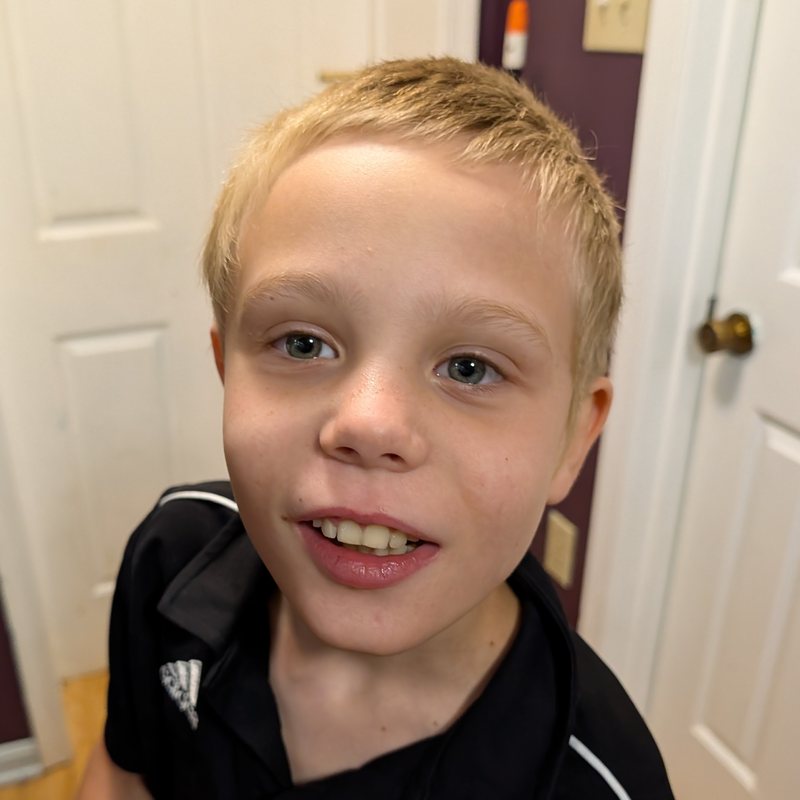
Meet Thomas
Thomas (Tommy to his family) is 10. A change in one gene, LRRC4, affects how the connections in his brain form. We're working to find a therapy for it, and we'd like your help.
Who he is
Thomas loves music, especially movie soundtracks and the songs from his favorite shows. He doesn't use spoken words, so the people who know him best learn to read his expressions and routines. He needs someone with him around the clock and help with nearly everything in his day.
A few of his favorites:
- Moana
- Frozen & Frozen 2
- Encanto
- Sing
- Coco
- Sesame Street
- Daniel Tiger
- Spider-Man
- PJ Masks
- Super Simple Songs
What we know
One gene
Genetic testing (whole exome sequencing) found a single change in Thomas's LRRC4 gene. It stops the gene from making a working protein. This is called a loss-of-function variant.
What LRRC4 does
LRRC4 makes a protein called NGL-2. It helps brain cells build and hold their connections (synapses), and it helps keep the brain's "go" and "stop" signals in balance.
How it shows up
Thomas has autism, intellectual disability, and ADHD. He is non-speaking. In 2026 he started having seizures, which added new medical and safety challenges.
Why there's hope
When a single gene is missing, putting a working copy back (gene replacement) is a realistic scientific path. There are already mouse models and an existing gene therapy construct for LRRC4.
Where we are
- Diagnosis
Whole exome sequencing identified the LRRC4 variant as the cause of Thomas's condition.
- 2024
Enrolled in the Genetics of Epilepsy and Related Disorders research study at Boston Children's Hospital.
- June 2026
Thomas had his first major seizure and was admitted to the pediatric ICU. He's now on anti-seizure medication.
- July–August 2026
We contacted the new Center for Therapeutic Genetics (Broad Institute, Boston Children's, and The Jackson Laboratory). They referred us to The Jackson Laboratory's preclinical team.
- September 2026
We had our first meeting with the Rare Disease Translational Center at The Jackson Laboratory (JAX). The plan is to test the existing LRRC4 construct in cells first, looking at safety and at whether it makes too much protein, before deciding on mouse studies.
- Now
We're collecting what's already known about the construct from its manufacturer, waiting on JAX's scope for the cell-based screen, and presenting Thomas's story at the Pediatric Rare Disease Summit in Boston (October 9).
How you can help
Researchers
We'd like to hear from you if you work on LRRC4/NGL-2 or synaptic adhesion proteins, AAV dosing for the brain, or how to measure rescue in cells and mice (for example, electrophysiology or EEG).
Clinicians
If you see a child with epilepsy and developmental delay and no known cause, please consider LRRC4. If you have a patient with an LRRC4 variant, we'd like to connect with their family.
Families
If your child has an LRRC4 variant, please reach out. Every family who joins makes the case for research stronger, and none of us should have to do this alone.
Foundations & funders
Preclinical work (cell screening, then mouse dose-ranging) is the next big step. We'd like to talk with groups that fund ultra-rare, single-gene therapies.
Get in touch
Rich Shea, Thomas's father
richshea@gmail.com · (703) 930-1655
Researchers and clinicians can request access to Thomas's detailed clinical and research briefing (genetic variant, clinical history, construct status, and open scientific questions).